

I floated 425 kilometres down the Waikato River on a lilo as a coping mechanism to avoid going to therapy.
That’s also not how I pitched it at the time. At the time I said I was turning pain into adventure, getting fit, giving myself something to work towards. All of which was technically true. What was also true, and what I was considerably less honest about, was that I was really, really depressed and someone suggested a big goal might fix it. A big, exciting, public goal. Something to focus on that wasn’t the actual problem.
The depression didn’t care. It was still there when I got off the river. I just had a better story to tell about it.
Here’s what I’ve come to understand since then: this is what a lot of goals actually do. Not fix the problem. Give you somewhere else to look.
The Research Backs It Up
Roy Baumeister and colleagues at Florida State University found that when people are in emotional distress, regulating that feeling consistently takes priority over their other goals, including ones they’d committed to. In their words; feeling bad makes people do it, whatever “it” happens to be. The research suggests that a significant portion of what looks like goal pursuit is actually emotion management dressed up as ambition. Not because people are lying to themselves, but because the brain gets there first.
The Driver’s Test
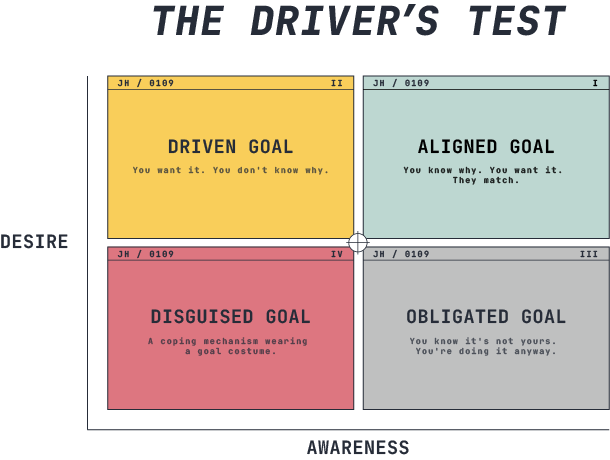
After years of working with people on their goals, and a fair bit of uncomfortable self-examination, I built a framework I call The Driver’s Test. The idea is simple: before you commit years of your life to a goal, you run it through two questions. Do you actually want this? And do you really know why?
Those two axes produce four very different situations.
Disguised Goals sit at low Awareness and low Desire. You’re chasing this on autopilot. You haven’t asked why, and if you’re honest, you don’t really want it. It’s a coping mechanism wearing a goal costume. Training for a half marathon to avoid sitting still, because sitting still means thinking about your Dad. Building a side hustle to escape the quiet of an unhappy relationship. Grinding for a promotion you never actually wanted because everyone around you is grinding for one.
Obligated Goals sit at high Awareness and low Desire. You’ve done the work, you can see this goal isn’t really yours but you’re doing it anyway: out of duty, guilt, momentum or fear of what happens if you stop. Taking over the family business because your parents built it, even though you’d rather be a teacher. Finishing the PhD because you’re three years in, not because you still want to be an academic. These goals are heavy in a specific way: you understand exactly what’s happening and you keep going regardless.
Aligned Goals sit at high Awareness and high Desire. You know why you want this, and you actually want it. The goal and the driver match. If it disappeared tomorrow, you’d feel genuine loss rather than relief. Writing the book because you’ve got something to say and you’d write it even if nobody read it. Building the business because the work itself lights you up, not because of what it’ll prove. This is the only quadrant where goals do what they’re supposed to.
Driven Goals sit at low Awareness and high Desire. And this is the one most goal frameworks miss entirely.
The Interesting Quadrant
You want it. Badly. You can feel the pull. You just haven’t looked underneath it yet. And most people don’t bother because strong desire feels like a green light.
The strongest wanting often comes from the deepest avoidance.
After the Lilo trip I kept going. I built the World’s Biggest Waterslide! More adventure, more story, another massive thing to point at. And I wanted it, genuinely. What I was less honest about was the layer underneath: I was also reinforcing an identity. The guy who had been through it and come out the other side, healed, sorted, helping others… Look at him go!
That’s Driven Goal territory. I had enough self-awareness from the Lilo trip to construct goals that looked meaningful from the outside but what I was missing was the awareness to look at what was actually driving the wanting.
- Obsessed with hitting a million dollars, without knowing what you’d actually do once you got there.
- Desperate to start a family by a specific age, but the desperation has more energy than the wanting.
- Famous, specifically, but with no clear answer for why fame rather than impact or craft or money.
These are Driven Goals. The desire is real but the driver hasn’t been examined.
Literally Running
I’ve worked with a lot of endurance athletes, people who sign up for progressively harder events year after year. A significant number of them are, quite literally, running away from their problems.
The marathon training plan is a brilliant place to hide. It’s healthy, it’s socially admired, it keeps you exhausted and busy and surrounded by people who all have race-day to focus on. Nobody asks hard questions of someone training for their sixth ultra. Most of them are sitting in the Driven quadrant: the desire is genuine, the driver is unexamined, and the examining is precisely what the training is helping them avoid.
Running Your Goals Through It
Most people don’t do this audit because they already suspect what they’ll find. Knowing which quadrant your goal is in means you can’t unknow it, and that creates a choice you might not be ready to make. So the goal stays unexamined, the story stays intact, and the real thing you’re supposed to be dealing with keeps waiting.
There are two questions that will tell you what you need to know. They’re simple; they’re not easy.
The first: “When did you decide you wanted this, and what else was happening in your life at that point?”
The second: “If you achieved it tomorrow, what problem would still be there?”
Whatever comes up in that gap is usually closer to the actual work than the goal itself.
The Lilo and the Waterslide were some of the best experiences of my life and I genuinely don’t regret them. But if I’d been more honest and more aware about why I was doing them, I’d have gotten a hell of a lot more out of it. Instead of arriving at the end with a great story and an unchanged problem, I might have actually dealt with the problem.
A lot of goals are coping mechanisms in disguise. The question isn’t whether yours is; it’s whether you know.
Much love,

If this resonated, guess what?! I write about this kind of thing in my weekly newsletter – practical frameworks for people who actually want to change, not just feel like they are. Sign up here;